


What do we mean by “Shared Risk and Protective Factors”? And how can this framework guide our cross-movement collaborations?
Shared risk and protective factors is a cross-movement collaboration framework used in public health prevention efforts, including violence prevention. For some anti-violence practitioners, cross-movement thinking comes naturally and collaborations feel inherent to the process of anti-violence work. For others, it may feel overwhelming. When planning cross-movement collaborations, the shared risk and protective factors framework can provide a template for leveraging each partners’ strengths to increase all partners impact. Imagine it this way…
- For each form of violence, communities and public health researchers have identified evidence-backed risk and protective factors. Risk factors are things that are statistically correlated with higher likelihoods of perpetrating or experiencing a certain kind of violence, even if they are not ‘causal’ – meaning they don’t themselves cause the violence to happen. Protective factors are things that are statistically correlated with lower likelihoods of perpetrating or experiencing a certain kind of violence, or that are associated with better long-term outcomes, even if they are not causal.
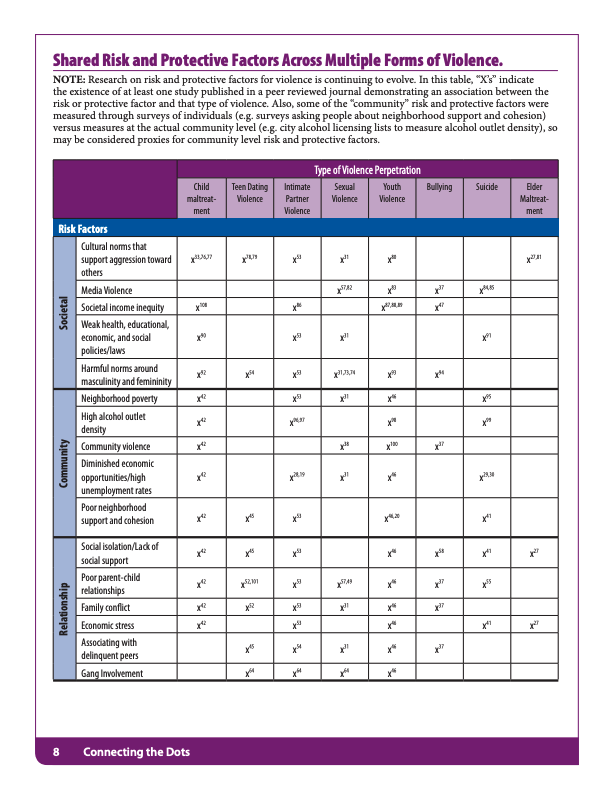
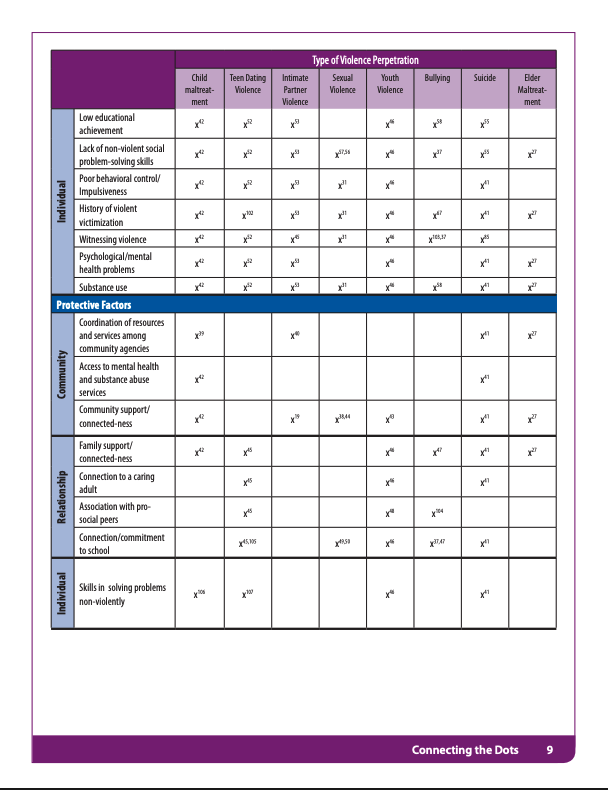
- While not all risk or protective factors apply to all forms of violence, some apply to more than one. For example, “cultural norms that support aggression toward others” is a risk factor for child maltreatment, teen dating violence, intimate partner violence, sexual violence, youth violence, and elder maltreatment. “Social isolation/lack of social support” is a risk factor for child maltreatment, teen dating violence, intimate partner violence, youth violence, bullying, suicide, and elder maltreatment. “Coordination of resources and services among community agencies” is a protective factor against child maltreatment, intimate partner violence, suicide, and elder maltreatment.
- One strategy for cross-movement collaboration is to find out what the shared risk and protective factors are, and collaborate to address those. Using the above examples, a group working on elder maltreatment, a child maltreatment NGO, and activists from the local feminist group working to address intimate partner violence could: 1) co-host community-building activities to strengthen social ties, 2) collaborate on a social media campaign to address violent cultural norms, and 3) meet with local officials to advocate for coordinated entry and referral systems between community agencies – without any mission creep at all!
- Using this approach, the resources required to accomplish this can be shared across the three groups according to what each brings to the collaboration, whether it is funding, space for hosting, graphic design, contacts for networking, or time and labor. This means more impact for less resources.
Want to learn more? Check out the Centers for Disease Control document Connecting the Dots where you can download the PDF of a handbook that includes the two charts below.
Recommended citation: “Shared Risk and Protective Factors.” Movement Glossary. Collective Threads Initiative, 2026. https://www.collectivethreads.org (date accessed).